
Early Childhood Expansion and Palate Expanders for Kids in Franklin, WI
Call Us at 414-401-5950
Call Us at 414-401-5950
If your child’s dentist has mentioned a narrow upper jaw, you’re probably reading up on a palate expander for kids in Franklin, WI. At Franklin Pediatric Dentistry, early childhood expansion is one of the ways we guide growth for children whose jaws are still developing. It sounds like a big step, and most parents have a lot of questions before they feel comfortable with it. That’s expected. Our job at the first visit is to look closely, explain what we see in plain terms, and tell you honestly whether your child needs treatment now, later, or not at all.
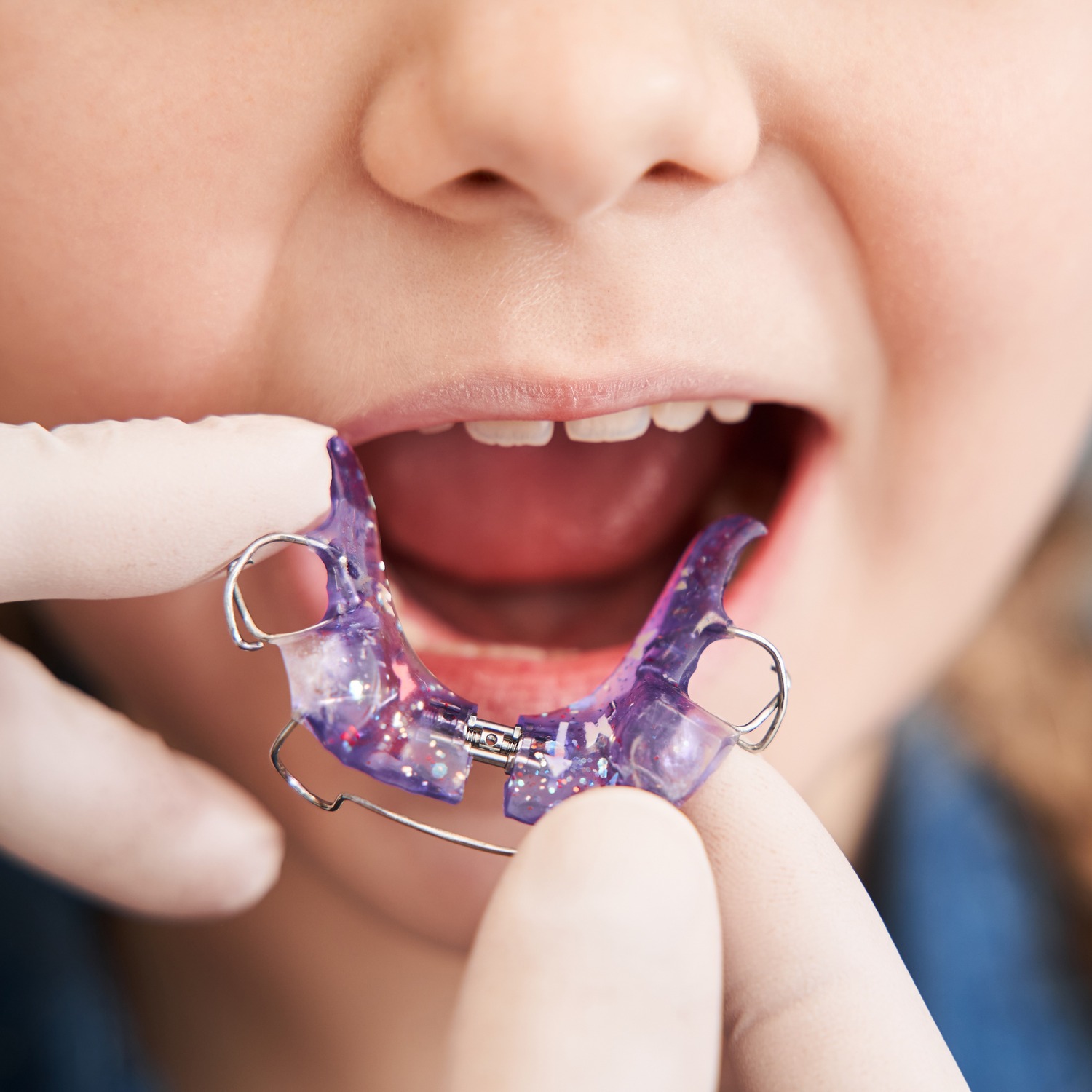
Expansion works on the upper jaw. Until the mid-teen years, its two halves are joined by a growth seam that runs down the middle of the roof of the mouth, called the midpalatal suture. A small expansion appliance attaches to the upper back teeth and applies gentle, steady outward pressure on that seam. With many designs, a parent makes a tiny adjustment at home on a set schedule. The seam opens a little at a time, and new bone fills in behind it. The active widening phase is usually a few weeks, and then the appliance stays in place for several months while the new bone firms up. Dr. Travis plans and monitors the whole process with regular check-ins.
Timing is the reason families come in sooner rather than later. Expansion tends to work best between about ages 4 and 10, while that seam is still flexible. After it fuses, widening the upper jaw usually takes more complex treatment and sometimes surgery. Dr. Travis is a board-certified pediatric dentist who has trained extensively with Dr. Marianna Evans, a leader in early childhood expansion and growth-focused orthodontic care. That training shapes how he decides who benefits and who just needs watching. There’s a breathing angle, too. The roof of the mouth is also the floor of the nose, so widening it can make breathing through the nose easier, something parents of mouth breathers, snorers, and nighttime grinders often want to understand.
Frequently Asked Questions About Early Childhood Expansion
What Is Early Childhood Expansion?
Early childhood expansion is orthodontic treatment that widens a narrow upper jaw while a child is still growing. Instead of pushing teeth through bone, it guides the bone itself, working with the natural growth seam in the palate. The goal is a wider, more stable upper arch that leaves room for permanent teeth and lets the upper and lower teeth meet properly.
It’s a different job from braces. Braces straighten individual teeth. Expansion builds the foundation those teeth will sit on, which is why it often comes first, sometimes years before a child is ready for full orthodontics.
What Is a 12-Tooth Smile?
A 12-tooth smile is a broad smile that shows teeth from first molar to first molar, six on each side, instead of just the front six or eight. It comes from the width of the upper jaw, not from the teeth themselves. When the arch is narrow, the back teeth sit tucked in and dark spaces show at the corners of the mouth. When the arch is wide, the smile fills the face from corner to corner.
That’s what Dr. Travis is looking at when he checks your child’s growth. A wide upper jaw means room for permanent teeth to come in, a roomier airway through the nose, and a full smile as your child grows up. Expansion at the right age builds that width while the jaw is still willing to grow, so the 12-tooth smile is something your child grows into instead of something we have to create later.
How Does a Palate Expander Work?
A palate expander slowly separates the two halves of the upper jaw along the center seam. The typical sequence looks like this:
- Dr. Travis takes records of your child’s teeth and bite so the appliance fits precisely.
- The expander is fixed to the upper back teeth at a short visit.
- During the active phase, the appliance is adjusted on a schedule we give you, often with a small key turned at home.
- Once the arch reaches its target width, adjustments stop and the expander holds steady while new bone fills the gap.
- We remove it and keep following growth at regular visits.
Many kids develop a small gap between their front teeth during widening. That’s a normal sign the expander is doing its job, and the gap typically narrows on its own afterward.
What Age Is Best for Palatal Expansion?
For most children, the best window for palatal expansion is between ages 4 and 10, before the growth seam in the palate begins to tighten. In that range the bone responds to light pressure. Some children are still good candidates at 11 or 12, depending on how far along their growth is. Once the seam fuses, usually in the mid-to-late teens, the same widening can take heavier appliances or surgical help.
That doesn’t mean every 5-year-old needs an expander. The American Association of Orthodontists recommends a first orthodontic check by age 7. At Franklin Pediatric Dentistry we start looking much sooner. Dr. Travis checks jaw width and growth at every routine visit, starting with your child’s first one, so a narrow jaw doesn’t have to wait until 7 to be noticed. If we see a narrowing pattern early, we’ll tell you. We’ll also tell you when waiting is the smarter call.
What Signs Suggest My Child Needs an Expander?
- A crossbite is the sign most people know, but it’s far from the only one. Many of the children we treat with expansion have no crossbite at all. Signs worth mentioning to us: Heavy grinding at night, or baby teeth that look worn flat
- Snoring, noisy breathing, or restless sleep
- Mouth breathing during the day or while asleep
- No spaces between baby teeth by age 4 or 5, which often means permanent teeth won’t have room
- Permanent teeth that are slow to come in, or that erupt behind or outside the row because there’s no space
- A high, narrow roof of the mouth
- A crossbite, or a jaw that shifts to one side when your child closes
Any one of these is a reason for a closer look, not proof that treatment is needed.
Does a Palate Expander Hurt?
Expanders usually don’t hurt, though most kids feel pressure for the first few days. After an adjustment, children often describe a tight or tingly feeling across the nose, cheeks, or front teeth that fades within minutes. The first week brings the biggest change: speech can sound a little different, and extra saliva is normal while the tongue gets used to the appliance.
Soft foods help early on, and a children’s pain reliever taken as the label directs can take the edge off if your child is sore. If anything feels sharp or the appliance seems loose, call us and we’ll check it.
How Much Does Early Childhood Expansion Cost?
Cost depends on the type of appliance, how long it needs to stay in, and how many follow-up visits your child needs, so we give families a specific figure after the evaluation instead of a guess. Guiding a narrow jaw early is often less involved than correcting it after growth is finished, which is part of the value of starting at the right time.
Some dental plans cover part of early orthodontic treatment, and coverage varies a lot between plans. Our team will review your benefits with you and explain your options before you commit. To get started, request an orthodontic evaluation for your child.
How Long Will My Child Wear an Expansion Appliance?
Most children wear an expansion appliance for roughly six months to a year in total. The active widening phase is short, often just a few weeks. The longer stretch is the holding phase, when the expander stays put without adjustments so the new bone can harden and the arch stays wide.
Every case is a little different. A child with a significant crossbite may need more time than a child with mild crowding, and some children wear a retainer afterward to hold the result. We’ll give you a timeline at the start and update it as we go.
Can Expansion Help with Snoring, Mouth Breathing, or Teeth Grinding?
It can help some children, but it isn’t a guaranteed fix. Because the palate is also the floor of the nasal cavity, widening it can widen the nasal passage and support nasal breathing. Some parents notice quieter sleep and less snoring once their child can breathe comfortably through the nose. A narrow upper arch can also make the bite feel unstable, and grinding is sometimes the jaw searching for a more comfortable position.
Grinding and mouth breathing have other causes too, including allergies, enlarged tonsils, stress, and sleep problems. When we see these signs, we look at the whole picture and may suggest your pediatrician or an ENT weigh in. Expansion is one tool among the pediatric dental services we offer to support healthy growth.
How Do We Eat, Brush, and Talk with an Expander?
Kids are usually eating, brushing, and talking normally within a week or two. A few habits make it easier:
- Skip sticky and hard foods like caramel, gum, popcorn, and hard candy, which can bend or loosen the appliance.
- Cut crunchy foods such as apples and carrots into small pieces.
- Brush around the expander after meals, and rinse or use a water flosser to clear food from underneath.
- Read out loud together for a few days. Speech settles quickly with practice.
Food getting packed under the appliance is the most common complaint, so a quick rinse after snacks goes a long way.
Will My Child Still Need Braces After Expansion?
individual teeth. If permanent teeth still come in crooked, braces may follow in the pre-teen or teen years, and that treatment is often simpler because the space problem was handled early. Braces can straighten teeth, but they can’t widen the jaw the way early expansion can. The broad, 12-tooth smile starts with the foundation.
Our practice also provides Phase 1 orthodontics and comprehensive braces, so the same team can follow your child from expansion through any later care. Our page on children’s orthodontics and early expansion explains how those stages fit together.
Why Choose Franklin Pediatric Dentistry for Early Childhood Expansion
individual teeth. If permanent teeth still come in crooked, braces may follow in the pre-teen or teen years, and that treatment is often simpler because the space problem was handled early. Braces can straighten teeth, but they can’t widen the jaw the way early expansion can. The broad, 12-tooth smile starts with the foundation.
Our practice also provides Phase 1 orthodontics and comprehensive braces, so the same team can follow your child from expansion through any later care. Our page on children’s orthodontics and early expansion explains how those stages fit together.
Book Your Child’s Expansion Evaluation with Our Team
A narrow jaw is much easier to guide at 6 than at 16, and a wide, 12-tooth smile is easier to grow than build. If you’ve noticed crowding, a crossbite, snoring, nighttime grinding, or mouth breathing, Franklin Pediatric Dentistry can check your child’s growth in Franklin, WI and tell you plainly whether expansion makes sense now or whether we should keep watching. The visit is relaxed: we look, take any records we need, and walk you through what we found before you leave. Call 414-401-5950 to schedule your child’s expansion evaluation.